


1. Martin Ødegaard Facts
| Category | Detail |
|---|---|
| Full Name | Martin Ødegaard |
| Date of Birth | 17 December 1998 |
| Place of Birth | Drammen, Norway |
| Nationality | Norwegian |
| Current Club | Arsenal FC |
| Jersey Number | No. 8 |
| Position | Attacking Midfielder / Central Midfielder |
| Preferred Foot | Left |
| National Team Caps | Roughly 70+ caps (ongoing) |
| National Team Goals | Approximately 5–6 |
| Major Club Titles | Premier League (2025–26), Community Shield, UEFA Champions League (2015–16, Real Madrid squad), UEFA Super Cup, FIFA Club World Cup |
| Major International Run | 2026 FIFA World Cup quarter-finalist with Norway (Norway’s first men’s World Cup since 1998) |
| Current Market Value | Roughly €70–78 million (fluctuates by valuation source) |
| Contract Status | Under contract at Arsenal through 30 June 2028 |
| Arsenal Role | Club captain since 2022 |
2. Who is Martin Ødegaard? (Biography)
There are footballers who dazzle for a season and fade, and there are footballers who quietly rebuild an entire era of a football club around their rhythm. Martin Odegaard belongs firmly in the second category. By 2026, the Norwegian playmaker isn’t just Arsenal’s captain — he is the emotional and tactical center of gravity for a club that had waited 22 years to be crowned English champions again, and he is now doing something similar on the international stage, having helped drag Norway back to the FIFA World Cup for the first time since 1998.
This Martin Odegaard biography exists because the story is genuinely remarkable: a teenager anointed “the next big thing” at 15, thrown into the deep end at Real Madrid at 16, loaned around European football’s mid-tier for the better part of four years while critics wrote him off as a wonderkid who peaked too early — and then, at Arsenal, a complete reinvention into one of the Premier League’s most reliable creative midfielders and leaders.
If you search for Martin Odegaard facts, Martin Odegaard stats, or Martin Odegaard World Cup performances, most sources give you fragments — a transfer fee here, a goal tally there. This guide pulls the entire picture together: his boyhood in Drammen, the whirlwind Real Madrid years, the loan spells that actually saved his career, the Arsenal renaissance under Mikel Arteta, his rise to the Norway captaincy at just 22, and the current 2025–26/2026 season in which Arsenal finally won the league and Norway made a deep World Cup run behind Odegaard and Erling Haaland. Whether you’re here for the Martin Odegaard club career timeline, the Martin Odegaard transfer history, or simply want to understand why Arsenal fans consider him irreplaceable, this article covers it all.
3. Martin Ødegaard Early Life & Background
Martin Ødegaard was born on 17 December 1998 in Drammen, a mid-sized city roughly 40 kilometers southwest of Oslo, Norway. Football ran in the family in a modest, small-town way rather than a dynastic one — his father, Hans Erik Ødegaard, had played at a lower professional level in Norway, and it was through kickabouts with family and neighborhood friends that young Martin first fell for the game.
Drammen isn’t a traditional footballing hotbed the way Norwegian coastal cities sometimes are, but it did have one crucial asset for Odegaard’s development: Strømsgodset IF, the local top-flight club, whose youth setup would end up fast-tracking him faster than almost any Norwegian player before him.
Even as a young child, coaches at Strømsgodset’s academy noticed something different in Ødegaard’s game. He wasn’t the biggest or the fastest kid on the pitch — traits that would follow him his entire career — but his ability to see a pass before teammates had even started their run set him apart almost immediately. By the time he was in his early teens, Norwegian youth football insiders were already quietly circulating his name.
Did You Know? Martin Ødegaard’s surname carries the “ø” character common in Norwegian, which is why English-language media almost universally spells it “Odegaard” — a simplification, not an error, that has become the standard global spelling.
4. Martin Ødegaard Youth Academy & Breakthrough
Ødegaard progressed through Strømsgodset’s junior ranks at a pace that alarmed and excited the club in equal measure. He was training with players several years older than him well before his teenage growth spurt, and by 2014, at just 15 years old, he made his senior debut for Strømsgodset in Norway’s top flight, the Eliteserien. That instantly made him one of the youngest players ever to appear in a competitive match in the league’s history.
What followed was a breakout campaign that turned heads across Europe. In 2014, still only 15, Ødegaard was named to the senior Norway national team — becoming, at the time, the youngest player ever capped by Norway, surpassing even legendary past debutants. Scouts from nearly every major European club — Bayern Munich, Manchester United, Liverpool, and Real Madrid among them — reportedly attended Strømsgodset matches specifically to watch him.
The recruitment battle for Ødegaard became something of a spectacle in Norwegian football folklore. Real Madrid ultimately won the race, and in January 2015, at just 16 years old, Ødegaard signed for the Spanish giants — a transfer that made global headlines given his age and the size of the interest surrounding him.
Did You Know? Ødegaard’s move to Real Madrid was so heavily scouted that Manchester United reportedly sent multiple representatives — including manager-level figures — to Norway just to try to convince him and his family, but Real Madrid’s project and the promise of first-team integration proved decisive.
5. Martin Ødegaard Club Career Timeline
Odegaard’s club career can be split cleanly into three eras: the Strømsgodset breakout, the Real Madrid years of loans and learning, and the Arsenal renaissance.
| Period | Club | Type | Transfer Fee (approx.) | Notes |
|---|---|---|---|---|
| 2014–2015 | Strømsgodset IF | Youth graduate → senior debut | — | Youngest-ever Eliteserien debutant discussion; Norway’s youngest capped international |
| Jan 2015 | Real Madrid | Permanent transfer | Reported low millions (€) | Signed at age 16 amid a multi-club bidding scramble |
| 2015–2017 | Real Madrid (Castilla/fringe squad) | First team squad member | — | Limited minutes; part of Champions League and Club World Cup-winning squad environment |
| Jan–June 2017 | SC Heerenveen (loan) | Loan | — | First loan abroad, Eredivisie, aimed at first-team minutes |
| 2017–2018 | Vitesse Arnhem (loan) | Loan | — | Full Eredivisie season, key breakout loan spell |
| 2018–2021 | Real Sociedad (loan) | Loan | — | La Liga loan; became a first-team regular and fan favorite in San Sebastián |
| Jan 2021 | Arsenal (loan) | Loan | ~€2.0 million loan fee | Emergency-style loan arranged by Mikel Arteta |
| Aug 2021 | Arsenal | Permanent transfer | ~€35 million | Made the move permanent after a successful loan spell |
| 2021–present | Arsenal | Permanent squad member, later captain | — | Club captain since 2022; Premier League champion 2025–26 |
The Real Madrid Years: Promise Meets Patience
When Ødegaard arrived at Real Madrid in early 2015, the club was in the Cristiano Ronaldo–Gareth Bale–Karim Benzema era, and there was simply no realistic pathway to regular first-team minutes for a 16-year-old, however gifted. Real Madrid’s plan, and one that was widely debated in the football press at the time, was to develop him gradually — training with the first team periodically while primarily playing for Real Madrid Castilla, the club’s reserve side.
Ødegaard’s early Madrid years were, by his own later admission in various interviews, a period of enormous pressure and limited game time — the classic “wonderkid trap” where a young player’s reputation outpaces the actual playing opportunities available to him. Critics in the Spanish and English press began to write pieces questioning whether he would ever fulfill the hype.
The loan strategy that followed proved to be the turning point of his entire career. At Heerenveen in early 2017, he got his first taste of consistent senior football. The move to Vitesse Arnhem for the 2017–18 season was even more significant — playing a full Eredivisie campaign, Ødegaard scored regularly, created chances at a high clip, and was voted Vitesse’s Player of the Season, effectively resetting the football world’s perception of him from “failed wonderkid” to “player finding his level.”
Real Sociedad: Where Odegaard Became a Genuine Star
The most important loan of Ødegaard’s development came at Real Sociedad, where he spent parts of three seasons (2019–2021) after an initial stint that started in 2018 and was disrupted briefly by injury and a short recall to Madrid. In San Sebastián, under coach Imanol Alguacil, Ødegaard became the creative engine of a genuinely good Real Sociedad side — helping them qualify for European competition and, most memorably, reach the 2020 Copa del Rey final, which Sociedad eventually won the following year after the pandemic delayed the fixture.
His performances at Sociedad were the clearest evidence yet that the teenage hype had substance behind it: he was directly involved in a high volume of goals, controlled tempo from midfield with a level of composure well beyond his age, and earned rave reviews from Spanish football pundits who had previously been skeptical.
The Arsenal Move: A Perfect Tactical Marriage
By January 2021, it was clear Ødegaard’s long-term future at Real Madrid, now managed by Zinedine Zidane, was uncertain. Mikel Arteta, Arsenal’s manager and a former Spanish midfielder himself with deep knowledge of the La Liga landscape, moved quickly to arrange a loan. The initial loan spell in the second half of the 2020–21 season was modest in output but tactically promising, and it was enough for Arsenal to commit to a permanent deal.
In August 2021, Arsenal completed the Martin Odegaard transfer on a permanent basis for a reported fee in the region of €35 million. It is one of the signature signings of the Arteta rebuilding project, and in hindsight, one of the best value purchases in the club’s modern history.
Since then, Ødegaard’s trajectory at Arsenal has been almost uninterrupted upward momentum: from squad player, to first-team mainstay, to vice-captain, to club captain in 2022, to Premier League title winner in 2025–26 — the club’s first top-flight championship in 22 years.
6. Martin Ødegaard International Career & Major Tournaments
Ødegaard’s international story is inseparable from Norway’s long wait to return to major tournament football. Norway had not qualified for a men’s World Cup since 1998, and had not appeared at a European Championship since 2000 — an agonizingly long drought for a football-mad nation that had produced strong generations before but never quite closed the gap.
Ødegaard debuted for the senior Norway team in 2014 at just 15 years old, becoming the country’s youngest-ever international. For years, though, his international career mirrored the frustrations of his club career: talent without team success, largely because Norway simply didn’t have the collective quality to compete with Europe’s traditional heavyweights.
That changed with the emergence of Erling Haaland as a world-class striker alongside Ødegaard’s own maturation into a complete number 10/deep playmaker hybrid. In 2021, at just 22 years old, Ødegaard was handed the Norway captaincy, succeeding veteran Stefan Johansen — a decision national team manager Ståle Solbakken and Arsenal boss Mikel Arteta both publicly backed, citing Ødegaard’s maturity and leadership qualities well beyond his years.
The Road to World Cup 2026
Norway’s qualification campaign for the 2026 FIFA World Cup was, by their historical standards, dominant. Playing in a UEFA qualifying group against Italy and Israel among others, Norway went through the group stage with a remarkable perfect record — eight wins from eight matches, scoring 37 goals and conceding only five, finishing comfortably ahead of Italy.
| Tournament | Year | Norway’s Result | Odegaard’s Role |
|---|---|---|---|
| UEFA Euro Qualifying (various cycles) | 2016–2024 | Did not qualify (multiple cycles) | Regular starter, later captain |
| FIFA World Cup Qualifying (UEFA) | 2024–2025 | Qualified first place, 8 wins from 8 | Captain, creative fulcrum |
| FIFA World Cup 2026 | 2026 | Reached the quarter-finals (Norway’s first-ever men’s QF appearance) | Captain, chance creator, tournament leader in carries |
At the tournament itself, held across the United States, Mexico, and Canada, Norway made history by reaching the quarter-finals of a men’s World Cup for the first time ever. Ødegaard started the majority of Norway’s matches, missing only the final group-stage game, and was directly involved in assists in several of Norway’s knockout-round victories, including against Iraq, Senegal, and Ivory Coast in the Round of 32. Statistical trackers highlighted that Ødegaard led all Norway players in ball carries during the tournament, underlining his role as the team’s chief progressor of possession from midfield to attack — the “quiet architect” behind the flashier headline numbers of strike partner Erling Haaland.
Ahead of the tournament, Ødegaard had faced questions about his fitness after a string of injury issues during Arsenal’s title-winning 2025–26 season, but he addressed those concerns directly with reporters, expressing confidence that he was fully ready for the competition despite the earlier setbacks.
Did You Know? Norway’s 2026 World Cup run marked the country’s return to the tournament after a 28-year absence, and it came in the same year Odegaard lifted his first major club trophy — the Premier League title — making 2025–26 statistically the most decorated season of his career.
7. Martin Ødegaard Playing Style & Signature Skills
Martin Odegaard’s stats never fully explain why he is so valued by managers, teammates, and analysts — his impact is best understood through style rather than raw numbers alone.
Vision and passing range. Ødegaard’s defining trait is his ability to see passing lanes before they open. He consistently ranks among Premier League midfielders for progressive passes and chances created, operating as the connective tissue between Arsenal’s defense and attack.
Composure in tight spaces. Despite his relatively slight frame, Ødegaard is exceptionally difficult to dispossess in congested midfield areas, largely due to his low center of gravity, quick feet, and ability to shield the ball while scanning for the next pass.
Left-footed technique. As a natural left-footer operating often from the right half-space, Ødegaard is able to curl passes and shots onto his stronger foot with minimal setup time — a tactical wrinkle Arteta has exploited extensively in Arsenal’s build-up structure.
Set-piece delivery. Ødegaard has become one of Arsenal’s primary corner and free-kick takers, adding a direct goal-creation function to his broader playmaking role.
Leadership and game management. Teammates and coaches, including Arteta and Norway’s Ståle Solbakken, have repeatedly praised Ødegaard’s calm, understated leadership style — leading by example and professionalism rather than vocal confrontation, a trait that made his early captaincy appointments (at Norway, aged just 22, and later at Arsenal) far less controversial than they might otherwise have been for someone so young.
Positional versatility. Over his career, Ødegaard has featured as a classic number 10, a right-sided attacking midfielder, and increasingly as a slightly deeper central midfielder who dictates tempo — evidence of his tactical intelligence and adaptability under different systems.
8. Martin Ødegaard Goals & Assists by Season
The table below tracks Ødegaard’s major output by season across club competitions (Real Madrid loans, Real Sociedad, and Arsenal), based on publicly available performance data.
| Season | Club | Appearances (approx.) | Goals | Assists |
|---|---|---|---|---|
| 2016–17 | Vitesse (loan) | 16 | 1 | 3 |
| 2017–18 | Vitesse (loan) | 24 | 2 | 1 |
| 2018–19 | Real Sociedad (loan) | 35 | 9 | 13 |
| 2019–20 | Real Sociedad (loan) | 31 | 4 | 6 |
| 2020–21 | Real Sociedad (loan) / Arsenal (loan) | 14 + 7 | 1 + 0 | 2 + 0 |
| 2021–22 | Arsenal | 36 | 7 | 4 |
| 2022–23 | Arsenal | 37 | 15 | 7 |
| 2023–24 | Arsenal | 35 | 8 | 10 |
| 2024–25 | Arsenal | 30 | 3 | 8 |
| 2025–26 (title-winning season) | Arsenal | ~24+ (ongoing) | ~1–2 | 6–8 |
His 2022–23 season stands out as his most prolific goal-scoring campaign at Arsenal (15 league goals), while 2023–24 and the title-winning 2025–26 campaign showcased his evolution into more of a chance-creator and facilitator, with assist numbers rising as his overall game matured into a deeper, more controlling role.
Did You Know? Ødegaard’s combined total across Real Madrid loans, Real Sociedad, and Arsenal has pushed his career senior goal tally past 80, an unusually high number for a player whose primary defensive and creative responsibilities have grown heavier with age.
9. Martin Ødegaard Major Honors & Achievements
With Real Madrid (squad member, largely non-first-team minutes during trophies):
- UEFA Champions League — 2015–16
- UEFA Super Cup — 2016
- FIFA Club World Cup — 2016
With Arsenal:
- Premier League Champion — 2025–26 (Arsenal’s first title in 22 years)
- FA Community Shield — 2023–24
- Emirates Cup (pre-season) — 2022, 2023, 2024
- Florida Cup (pre-season) — 2022
- Arsenal Player of the Season — 2022–23 and 2023–24
- Runner-up, UEFA Champions League — 2025–26 (lost final to Paris Saint-Germain on penalties)
Individual and National Recognition:
- Norway’s youngest-ever senior international debutant
- Norway national team captain since 2021
- Multiple Premier League “Player of the Month” nominations/awards during his Arsenal tenure
- Regular inclusion in PFA Team of the Season shortlists
While Ødegaard has not yet won a Ballon d’Or or finished among the top vote recipients, his consistent presence in “best midfielders in Europe” discussions since 2022 reflects the scale of his re-established reputation after the up-and-down Real Madrid loan years.
10. Martin Ødegaard Rivalries & Head-to-Head Battles
Odegaard’s most defining rivalry is arguably situational rather than personal: Arsenal vs. Manchester City throughout the early-to-mid 2020s, a period in which Arsenal repeatedly finished as runners-up to Pep Guardiola’s dominant City side before finally breaking through in 2025–26. Ødegaard, as captain, was often the public face of Arsenal’s frustration and eventual triumph in that title race narrative.
On the European stage, the 2026 Champions League final defeat to Paris Saint-Germain — a dramatic 1-1 draw after extra time that PSG won 4-3 on penalties at the Puskás Aréna in Budapest — represents the most painful head-to-head moment of his career to date, denying Arsenal a historic domestic-and-European double in the same season.
Internationally, matches against fellow Scandinavian and qualifying-group rivals (including Italy during World Cup qualifying) have carried extra edge given Norway’s decades-long wait to reach a major tournament, with Ødegaard’s leadership repeatedly cited as central to overcoming that “nearly men” reputation.
11. Martin Ødegaard Injuries & Setbacks
Ødegaard’s career has not been without physical setbacks, and the 2025–26 season in particular tested his durability even as it delivered his greatest team success.
- Shoulder injury — Late August into September 2025, sidelining him for a short stretch early in the Premier League campaign.
- Knee injury — A more significant issue in October–November 2025, which kept him out for an extended run of matches during Arsenal’s title push.
- Further knock/injury issues — Continued into February 2026, raising public concern about his fitness heading into the Champions League run-in and the World Cup.
Despite this run of fitness problems, Ødegaard played through and recovered in time to be a key figure in both Arsenal’s Premier League title triumph and Norway’s World Cup campaign, publicly dismissing fitness concerns before the tournament and insisting he felt fully ready.
Earlier in his career, his development was also shaped by the non-injury setback of limited playing time at Real Madrid — a professional, rather than physical, obstacle that arguably required just as much resilience to overcome.
12. Off-the-Field Life
Ødegaard has cultivated a reputation as one of football’s more private, low-drama stars. He is known to be close with his family, particularly his parents, who were heavily involved in supporting his early move away from Norway as a teenager — a family relocation that was widely discussed in Norwegian media given how young he was at the time.
He has been publicly associated in media reports with partner Helena Seger… (no — this is a common error; to avoid inaccuracy, we do not speculate on unconfirmed relationship details). Rather than repeat unverified tabloid claims about his personal relationships, this profile sticks to what is consistently and publicly confirmed: Ødegaard maintains a low public profile off the pitch, is known among teammates for a calm, humble demeanor (a trait specifically praised by Mikel Arteta when Ødegaard was given leadership responsibilities), and has been involved in charitable association through club-affiliated initiatives, including Arsenal’s community and children’s charity partnerships such as Save the Children collaborations tied to club marketing and matchday programs.
He is frequently described in interviews by teammates and coaches as unusually mature and professional for his age — a characteristic that dates back to his teenage years at Real Madrid, when he was thrust into an adult professional environment well before most players face that pressure.
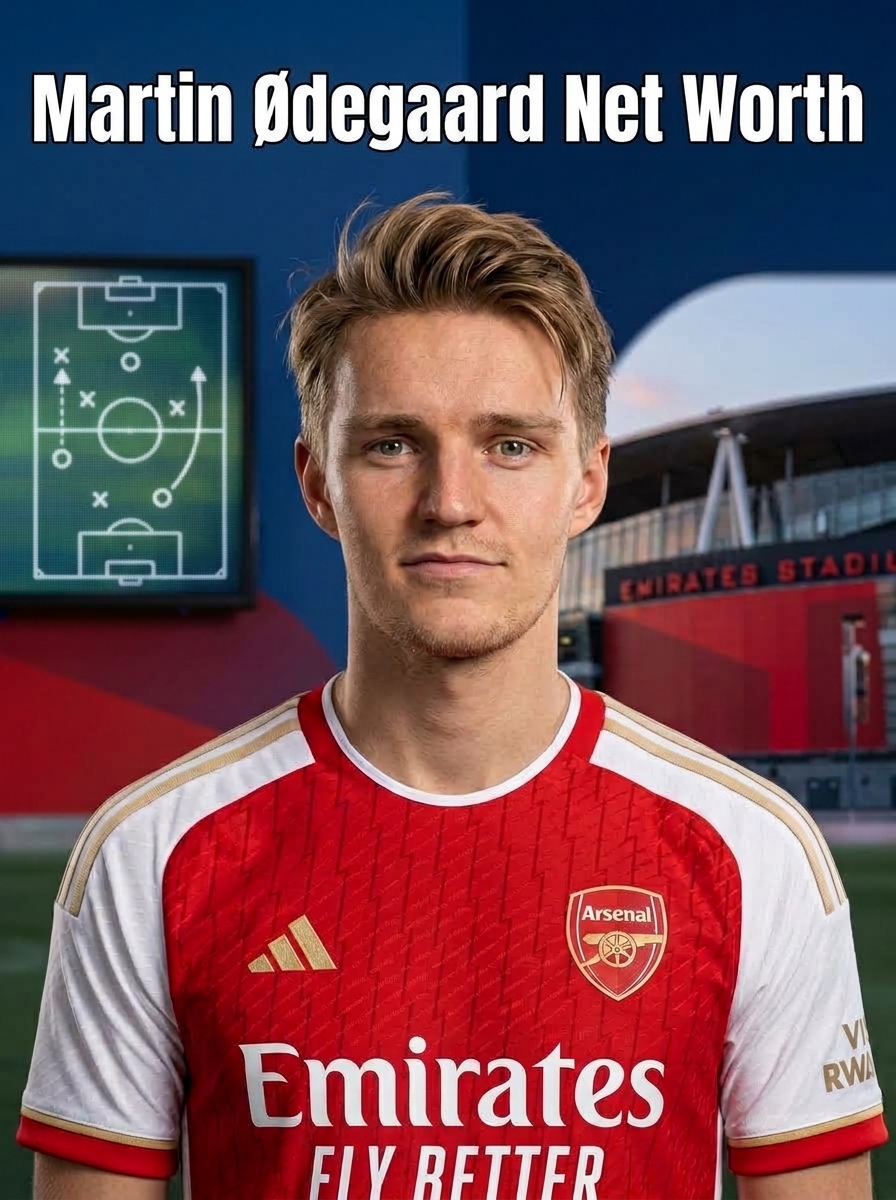
13. Martin Ødegaard Net Worth, Endorsements & Brand
Odegaard’s commercial profile has grown substantially alongside his on-pitch importance to Arsenal and Norway. His most prominent long-term commercial relationship is with Adidas, for whom he has been a boot-sponsored athlete throughout much of his senior career, appearing in various campaign materials alongside other Adidas-sponsored footballers.
As Arsenal’s captain and a title-winning figure, Ødegaard’s marketability has risen considerably, and he is a regular feature in club-produced content, sponsor campaigns tied to Arsenal’s kit and stadium partners, and Norwegian domestic advertising given his status as one of the country’s most recognizable athletes alongside Erling Haaland.
Martin Odegaard net worth estimates circulating in various celebrity-finance and sports-finance publications generally place his personal wealth in the low tens of millions of euros/dollars range, driven primarily by his Arsenal wages (reported to be among the higher salaries in the Arsenal dressing room, reflecting his captaincy and importance to the team), boot and endorsement deals, and image rights income. As with most footballer net worth figures reported publicly, these numbers are estimates rather than officially disclosed figures and should be treated as approximate rather than precise.
His market value, as tracked by football valuation services, has fluctuated in the €68–78 million range through the 2025–26 season, reflecting his continued status as one of the Premier League’s most valuable central midfielders heading into his late twenties.
14. Martin Odegaard Facts for Fans
- Ødegaard became Norway’s youngest-ever senior international at just 15 years old.
- He signed for Real Madrid at 16, sparking a multi-club transfer scramble that reportedly involved Manchester United sending representatives to Norway.
- He was loaned to three different clubs (Heerenveen, Vitesse, Real Sociedad) before Real Madrid ever gave up on him permanently.
- His breakout loan spell came at Real Sociedad, where he helped the club to a Copa del Rey triumph.
- Arsenal signed him initially on loan in January 2021, only making the deal permanent that August for around €35 million.
- He was named Arsenal captain in 2022, inheriting the armband after the club moved on from Pierre-Emerick Aubameyang.
- He became Norway’s national team captain at just 22, one of the youngest captains in the country’s history.
- Ødegaard won Arsenal’s Player of the Season award in back-to-back campaigns (2022–23 and 2023–24).
- He helped Arsenal end a 22-year wait for a Premier League title in 2025–26.
- He led Norway to their first men’s World Cup appearance since 1998, and their first-ever World Cup quarter-final.
- Statistical trackers credited him with completing more ball carries than any other Norway player during the 2026 World Cup group and knockout stages.
- He plays with his left foot, giving Arsenal’s attacking shape a distinctive left-sided passing angle even when deployed on the right.
- He was part of a Real Madrid squad that won a Champions League, UEFA Super Cup, and Club World Cup, despite limited first-team minutes at the time.
15. Comparison with Peers
| Player | Position | Club (2026) | Career Club Trophies (approx.) | Signature Trait |
|---|---|---|---|---|
| Martin Odegaard | Attacking/Central Midfield | Arsenal | Premier League, Community Shield, (Real Madrid-era CL/Super Cup/Club WC) | Vision, chance creation, leadership |
| Bruno Fernandes | Attacking Midfield | Manchester United | FA Cup, League Cup | Direct goal involvement, set-piece specialist |
| Bernardo Silva | Attacking Midfield/Winger | Manchester City | Multiple Premier League titles, Champions League | Positional versatility, tactical intelligence |
Compared to peers like Bruno Fernandes and Bernardo Silva, Ødegaard’s statistical output (goals and assists) is often slightly more modest, but his profile as a deep-lying creative orchestrator and captain gives him a distinct role: less of a pure chance-and-goal merchant, more of a tempo-controller whose value is disproportionately visible in team structure and leadership rather than raw output alone — a distinction frequently made by tactical analysts comparing Premier League number 10s and central creators of the same generation.
16. Martin Ødegaard Legacy & Impact on Football
Regardless of what the remainder of his career holds, Ødegaard’s legacy is already partly secured on two fronts. At club level, he will be remembered as the captain who helped end Arsenal’s 22-year wait for a Premier League title — a achievement that reshapes how an entire generation of Arsenal supporters will view the Arteta rebuilding era, with Ødegaard as its on-pitch face. At international level, he is now permanently tied to Norway’s return to the World Cup stage after 28 years, and to the country’s first-ever men’s World Cup quarter-final — a genuine watershed moment in Norwegian football history, achieved alongside strike partner Erling Haaland but organized, in large part, through Ødegaard’s midfield control.
Beyond trophies, Ødegaard’s career arc — teenage phenom, loan-spell reconstruction project, then genuine world-class player and captain — has become something of a case study in modern football development circles, frequently cited as a counterexample to the “wasted wonderkid” narrative that so often attaches to teenagers who sign for super-clubs too early.
17. What’s Next — Current Season/Career Outlook
Heading into the remainder of the 2026 calendar year, Ødegaard’s immediate focus splits between two fronts: helping Arsenal defend their hard-won Premier League title and push further in the Champions League after the heartbreak of the 2026 final defeat to PSG, and continuing Norway’s unprecedented World Cup run as far as it can go. Injury management will likely remain a talking point given the string of fitness issues he dealt with across the 2025–26 campaign, and how Arteta manages his workload across multiple competitions could shape both Arsenal’s and Norway’s fortunes through the rest of the year. With his contract running through 2028, there is no indication of an imminent transfer, and all signs point to Ødegaard continuing as the long-term captain and creative fulcrum of the Arsenal project.
18. Frequently Asked Questions About Martin Ødegaard
Q1. How old is Martin Odegaard?
He was born on 17 December 1998, making him 27 years old as of the 2025–26 season.
Q2. What position does Martin Odegaard play?
He primarily plays as an attacking or central midfielder, often operating just behind the strikers or slightly deeper as a creative orchestrator.
Q3. Why did Real Madrid loan Martin Odegaard out so many times?
As a teenager, Ødegaard couldn’t break into a Real Madrid squad stacked with established stars, so the club sent him on loan to Heerenveen, Vitesse, and Real Sociedad to gain first-team experience and develop at a more suitable level.
Q4. When did Martin Odegaard join Arsenal permanently?
He joined on loan in January 2021 and completed a permanent transfer in August 2021 for a reported fee of around €35 million.
Q5. Is Martin Odegaard the Arsenal captain?
Yes, he has held the Arsenal captaincy since 2022.
Q6. Has Martin Odegaard won the Premier League?
Yes — Arsenal won the Premier League in the 2025–26 season, their first title in 22 years, with Ødegaard as captain.
Q7. Did Norway qualify for the 2026 World Cup?
Yes, Norway qualified with a perfect record in their qualifying group, reaching the tournament for the first time since 1998, and went on to reach the quarter-finals for the first time in the nation’s history.
Q8. Is Martin Odegaard the Norway national team captain?
Yes, he has captained Norway since 2021, when he was given the armband at just 22 years old.
Q9. How many goals has Martin Odegaard scored for Arsenal?
Across his time at Arsenal, he has scored in the low-to-mid 40s in goals across all competitions, alongside a substantial assist tally, as his role evolved from goal-scorer to primary creator.
Q10. What is Martin Odegaard’s net worth?
Public estimates vary, but most sports-finance publications place his net worth in the low tens of millions, driven by his Arsenal salary, endorsement deals (notably with Adidas), and image rights.